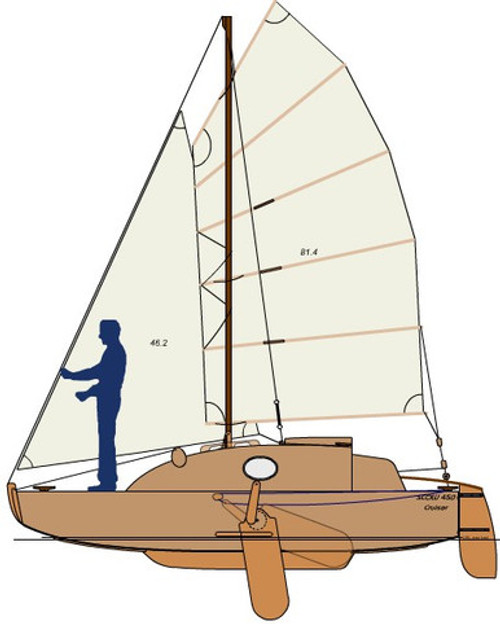


Micro Scow 4M Coastal Cruiser
Designed by Mark S. Palmquist
|
Specs: Micro scow 4M CC is modeled after the 6.5 meter mini Transat racing scows however, this version is for coastal cruising, not ocean crossing. It has been specifically designed for events like the Texas 200 or the Everglades Challenge where the waters are often very shallow. Micro Scow is one of the only sailboats that is 4M long that boasts a cabin for 2 and also has sit up headroom. This is one of the advantages of the rounded scow bow, besides good downwind performance. It features dual, kick-up leeboards and rudders. The sail layout is cat ketch, utilizing a reefable 89 SF balanced lug main and a 36 SF fully battened mizzen (offset). Righting moment is accomplished with either crew weight shifting, or water ballast, or sand bags secured to the floor or a combination of all the above. Another option is to add a float to the top of the mast. There is room for a small outboard motor on the starboard side. Features: The bottom and chines are 3-4mm thick Okoume Marine Plywood (or similar) Check the bending radius of your plywood (it must bend around a 36" Radius). The entire bottom of the boat will then need either 1 layer of thick fiberglass or 2 layers of thin glass Why the scow bow? Scows have been around for a long time. The moth class of boats at one point had scow hulls. Then the hulls got skinnier. There was a period of time when both the wide, rounded scow hulls would race with the narrow, pointy hulls at the same time. When the wind was up, the wide scows would win and when the wind was down, the skinnier pointy hulled boats would win. It was not until foils were added to the boats that all the moth boat hulls changed to the skinny hull shape. Interestingly, the designers of the Birdy fish foiling boat chose the scow hull because it increases rightly moment by having the crew weight further to windward. Recently, the shape of the scow bow boats has greatly improved, thanks to the mini Transat race which limits the overall hull length to 6.5M but does not limit the width of the boats and does not limit the sail area. What racing teams have discovered is that if you increase the width of the bow, increasing its volume, you can increase the sail area and not experience severe broach when sailing down the face of a wave and you can prevent the bow from burying and you can push the boat to a speed in knots which comes close to the length of the boat in feet. For instance, the mini Transat scows can approach 22 knots and they are 21.4 feet long. 2 major advantages to a scow bow: How does a scow bow hull perform going into the wind? The newer versions do quite well, only slightly slower than a pointy hulled boat. If you were racing 50% downwind and 50% upwind, the scow of the same length would win because the advantage downwind is greater than its disadvantage upwind, this is because of its larger sail area per length. Why don’t you just make the boat longer and pointier? Would this not make it go faster? Yes, but then it would take up more space in your garage and would cost more in materials. How to sail a scow: |